
The Most Dangerous Advice in Veterinary Medicine
If you have a young French Bulldog, Pug, or English Bulldog that snores, you have probably asked your local vet when you should fix their breathing. And you have probably heard this exact phrase:
“Let’s just wait and see. We can re-evaluate when they are 1 or 2 years old.”
When I review massive veterinary bills and denied insurance claims, this exact piece of advice is almost always the root cause of the financial disaster. In 2026, waiting for your flat-faced dog to “grow into their airway” is not just scientifically inaccurate; it is physically dangerous.
Delaying Brachycephalic Obstructive Airway Syndrome (BOAS) surgery does not save you money. It actually guarantees the surgery will be significantly more expensive, highly complicated, and far riskier for your dog. Here is exactly why the timeline matters, and the “sweet spot” age to book the procedure before the damage becomes irreversible.
The Science of “Secondary Collapse”
To understand why waiting is a terrible idea, you have to understand what happens inside your dog’s throat every time they take a breath.
When a Bulldog or Pug breathes through pinched nostrils (stenotic nares) and past an elongated soft palate, they have to suck in air with massive force. This creates extreme negative pressure in their throat. Imagine sucking on a thick milkshake through a flimsy paper straw—the straw eventually collapses on itself.
This is exactly what happens to your dog’s airway cartilage. According to the board-certified specialists at the American College of Veterinary Surgeons (ACVS) regarding Brachycephalic Syndrome, this chronic negative pressure eventually sucks the delicate tissues of the larynx (voice box) into the airway. These are called “Secondary Changes,” which include everted laryngeal saccules and, ultimately, laryngeal collapse.
Once the cartilage in the voice box collapses, it cannot be surgically fixed. You have missed the window. A simple soft palate trim will no longer cure them, and they will struggle to breathe for the rest of their life.
The “Sweet Spot” Age for BOAS Surgery
Modern veterinary surgeons have completely shifted their timeline for airway intervention. You want to operate after the dog has done most of their rapid puppy growing, but before the negative pressure destroys the cartilage in their throat.
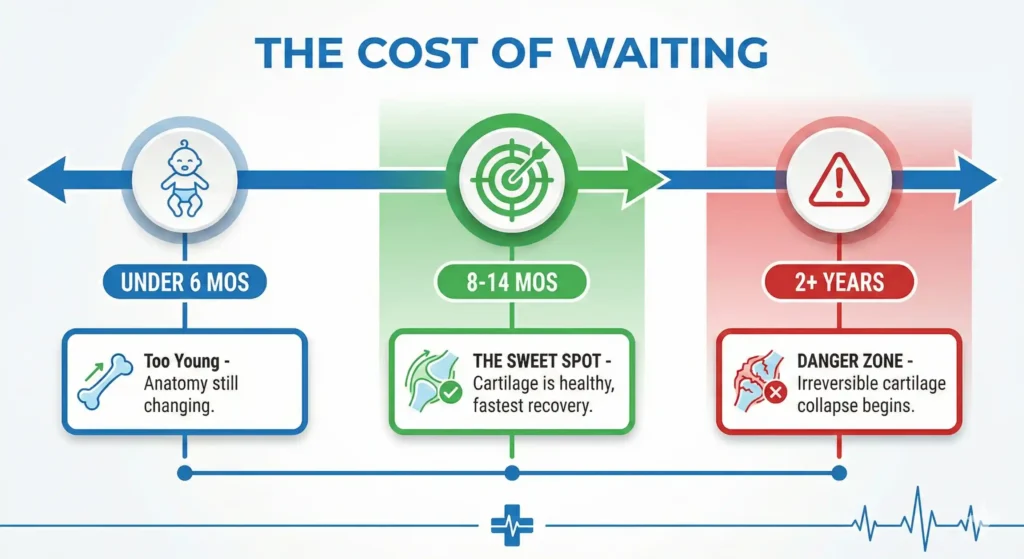
Under 6 Months (Too Early)
Unless your puppy is literally turning blue and suffocating, specialists rarely operate this early. The dog’s anatomy is still changing rapidly, and performing a palate resection too soon might mean they outgrow the repair and need a second surgery later. Additionally, pediatric anesthesia carries unique risks that surgeons prefer to avoid.
8 to 14 Months (The Golden Window)
This is the absolute sweet spot. At 8 to 12 months old, your Frenchie or Pug has reached near-adult size in their skull and throat structure. More importantly, they have not lived long enough for the chronic negative pressure to permanently warp their laryngeal cartilage. Surgery at this age is preventative. It stops the “paper straw” effect before it ruins their throat.
2 Years and Older (The Danger Zone)
If you wait until your dog is 2, 3, or 4 years old, the surgery transforms from a straightforward preventative procedure into a high-risk salvage operation. The surgeon will likely have to remove everted saccules, the recovery time is longer, the swelling risk is higher, and the total invoice will be thousands of dollars more expensive.
The Insurance Trap of Waiting
Beyond the physical danger to your dog, delaying surgery is the easiest way to void your pet insurance policy.
When you say, “I will just wait and see,” your dog is going to continue visiting the vet over the next two years for routine things like vaccines, ear infections, or an upset stomach.
During those visits, the vet will listen to your dog’s heart and lungs. If they hear loud, raspy breathing, they will write it in the medical chart. They might note that your dog occasionally regurgitates white foam (a classic symptom of BOAS).
By the time you finally decide to book the airway surgery at age 3, you have unintentionally allowed a massive paper trail of “respiratory distress” to build up in your dog’s medical records. When you submit the $5,000 surgical invoice, the insurance adjuster will point to those old vet notes, classify the severe BOAS as a Pre-Existing Condition, and deny the entire claim.
If you book the surgery during the “Golden Window” (8 to 14 months) right after your insurance waiting periods clear, you eliminate the chance of a paper trail ruining your coverage.
Combining Procedures: The “One and Done” Hack
One of the biggest expenses of BOAS surgery is the anesthesia and the overnight ICU monitoring.
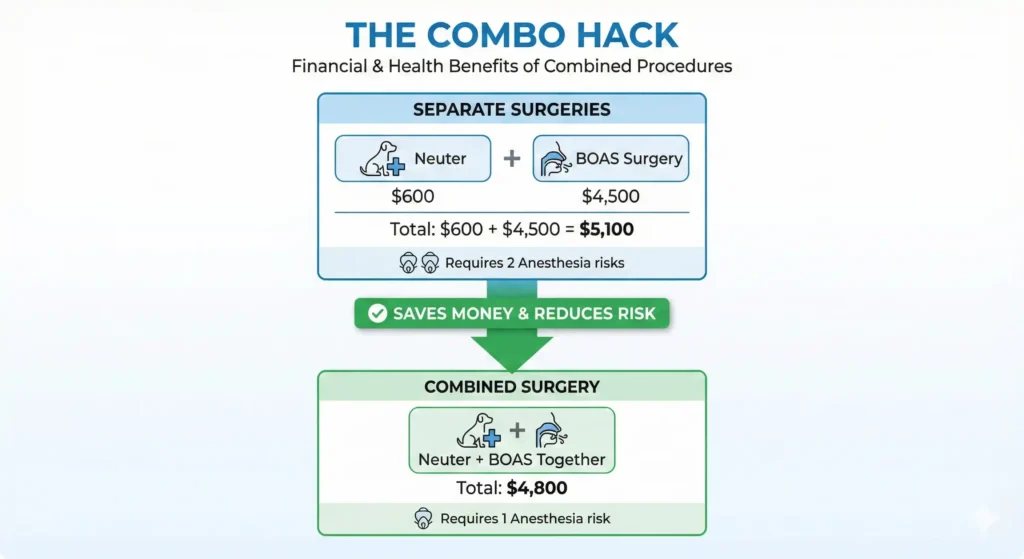
If you hit the 8 to 14-month age window perfectly, you can dramatically cut your costs by combining procedures. Many board-certified surgeons highly recommend performing the BOAS airway correction at the exact same time they spay or neuter your dog.
Because the dog only has to go under anesthesia once, you only pay the massive anesthesia and monitoring fee once. Your dog also only has to endure one recovery period. It is safer for their compromised airway and significantly better for your bank account.
Frequently Asked Questions (FAQs)
-
Can an older dog (7+ years) still safely get BOAS surgery?
Yes, but the risks are significantly higher. Older dogs often have secondary heart and lung issues from years of oxygen deprivation. A board-certified surgeon will require extensive chest X-rays, ECGs, and comprehensive bloodwork before clearing a senior flat-faced dog for airway anesthesia.
-
My puppy doesn’t snore yet. Do they still need the surgery?
Not necessarily. While nearly all Frenchies, Pugs, and English Bulldogs have some degree of brachycephalic syndrome, a small percentage have wide enough airways that they never require surgical intervention. However, you should still have a specialist evaluate their airway at the 10-month mark just to be absolutely sure.
-
Will pet insurance cover the spay/neuter if it is combined with BOAS?
Usually, no. Standard accident and illness policies do not cover elective spay/neuter surgeries. When your vet submits the combined invoice, the insurance company will separate the line items. They will reimburse you for the BOAS portion (if you met the waiting periods) but exclude the specific fees tied to the neutering.
YMYL & Financial Disclaimer: The information provided on Flat Face Insurance is for educational and consumer advocacy purposes based on my independent research of US veterinary practices. I am not a licensed veterinarian or a pet insurance underwriter. Every dog’s anatomical development is unique. Always consult directly with a board-certified veterinary surgeon (DACVS) to determine the safest surgical timeline for your specific pet, and review your insurance policy’s exact terms before scheduling a procedure.