
The $5,000 Difference: Same Surgery, Different Zip Code
You just got the quote from your local vet in New York or Los Angeles: $7,800 for BOAS Surgery.
You are in shock. You look at your bank account. You look at your wheezing Frenchie.
But what if I told you that the exact same surgery, performed by a board-certified specialist, costs $2,800 just a 10-hour drive away?
Welcome to the rise of “Pet Surgery Tourism.”
Insurance policies are national, but veterinary pricing is hyper-local. While coverage depends on your plan, the out-of-pocket gap depends on where you park your car. In this guide, we reveal which states are ripping you off, which states are the “Surgery Havens,” and how to get your insurance to play along.
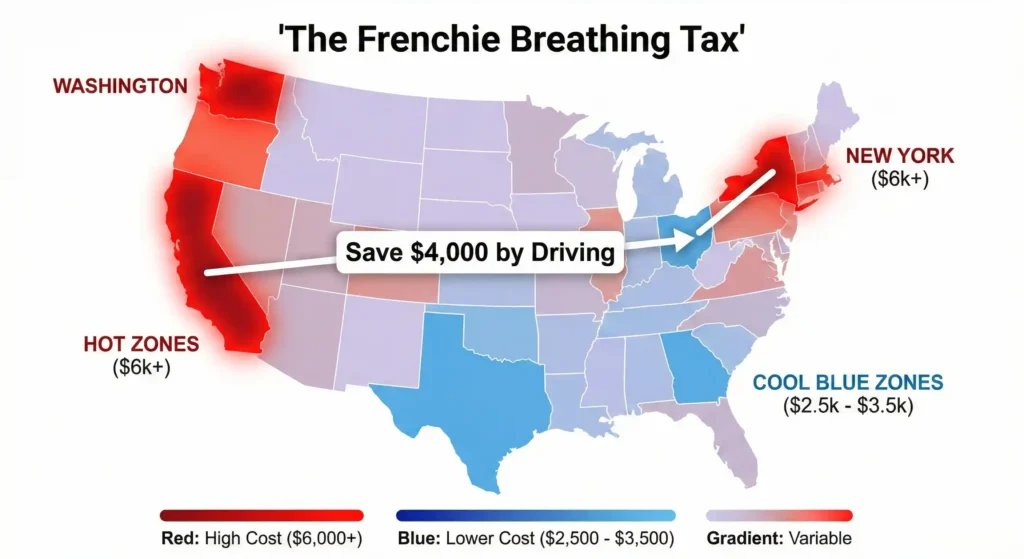
The “Red Zone”: Where BOAS Costs a Fortune
If you live in these states, you are paying a massive premium for real estate and labor costs, not better medical care.
1. California (The $6k – $9k Club)
Veterinary specialists in SF and LA have the highest overheads in the country. A standard soft palate resection and nares widening here is often priced like plastic surgery for humans.
2. New York & New Jersey
High demand and limited space drive prices up. Expect quotes to start at $5,500 and go up to $8,500.
3. Washington D.C. / Northern Virginia
Another hub of inflated veterinary costs.
The “Green Zone”: Best States for Surgery Tourism
Smart Frenchie owners are packing up the car and driving to these states. Even with a hotel stay and gas money, they save thousands.
1. Texas (The Gold Standard)
Texas has arguably the best ratio of High-Quality Specialists to Low Cost.
- Average Cost: $2,800 – $3,800.
- Why: Texas A&M University produces top-tier vets, and land/labor costs are lower.
2. Ohio & The Midwest
The Midwest is the hidden gem of veterinary care.
- Average Cost: $2,200 – $3,200.
- Why: Low cost of living means vets don’t need to charge NY prices to keep the lights on.
3. Florida (North/Central)
While Miami is expensive, Northern Florida offers very competitive rates for breathing surgeries.
- Average Cost: $3,000 – $4,500.
Does Insurance Cover “Out-of-State” Surgery?
YES. This is the best part.
Most US pet insurance plans (Lemonade, Trupanion, Healthy Paws, Spot) allow you to visit any licensed veterinarian in the United States.
They do not punish you for finding a cheaper vet. In fact, they love it because their payout is lower!
The “Pre-Approval” Strategy
Don’t just drive. Follow this protocol:
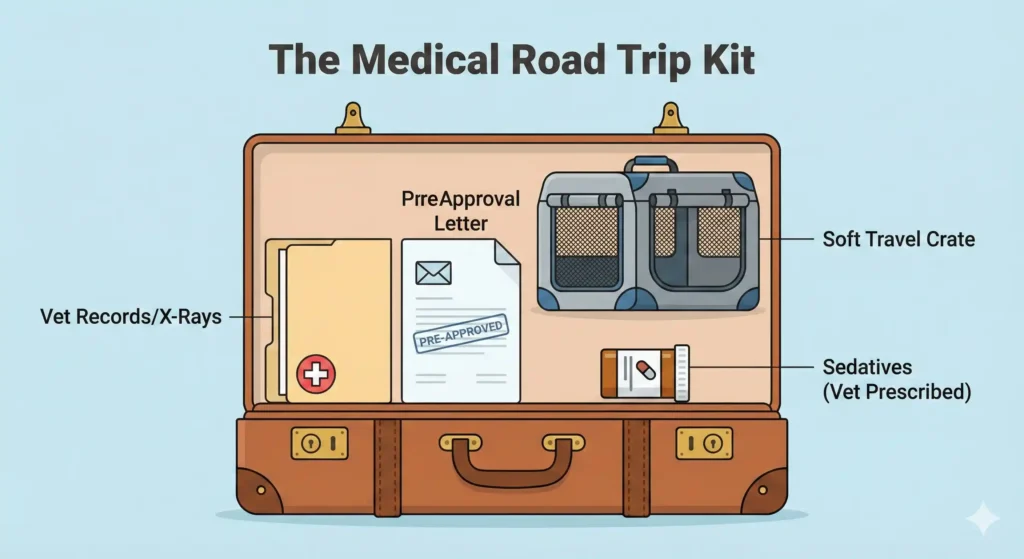
- Get the Quote: Call a specialist in Texas or Ohio. Email them your local vet’s notes and X-rays. Ask for a “High-End Estimate.”
- Submit for Pre-Approval: Send this estimate to your insurance company.
- Wait for the “Yes”: Once they confirm it is covered (and not pre-existing), pack your bags.
Is It Safe to Travel With a Breathing Problem?
This is critical. If your Frenchie is in severe respiratory distress (turning blue, fainting), DO NOT TRAVEL. You must go to the nearest ER immediately, regardless of cost.
Surgery tourism is for dogs who are stable but need the surgery to improve their quality of life.
- Drive, Don’t Fly: Flying with a BOAS dog is dangerous. Driving allows you to control the AC and take breaks.
- Plan for Recovery: You will need to stay in an Airbnb or pet-friendly hotel near the surgery center for 2-3 days post-op before driving home.
Frequently Asked Questions (FAQs)
-
Does pet insurance cover gas and hotels for surgery trips?
Usually, no. Standard policies only cover medical procedures. However, if you save $4,000 on the surgery and spend $500 on travel, you are still winning.
-
Can I get BOAS surgery done at a regular vet to save money?
We do not recommend this. BOAS surgery involves cutting delicate tissue near the airway. If it swells too much, the airway closes. Always seek a Board Certified Surgeon (DACVS). It is better to drive to a specialist in a cheaper state than to use a non-specialist in an expensive state.
-
What is the recovery time for soft palate surgery?
Most Frenchies stay in the hospital for 12-24 hours for observation. Once home, they need strictly limited activity (no running/playing) for 10-14 days.