

The Illusion of the Purchase Price
When you finally hand over $4,000 to a breeder for a French Bulldog puppy, you feel like the hard financial part is over. You buy a nice bed, a harness, and some premium kibble, thinking your monthly dog budget is set.
This is the biggest financial illusion in the canine world.
When I analyze the financial data of new Frenchie owners, the reality is brutal: the purchase price of the dog is just the down payment. What follows is the “Frenchie Tax”—a relentless wave of specialized veterinary bills that can easily double the cost of the dog in the first 12 months alone.
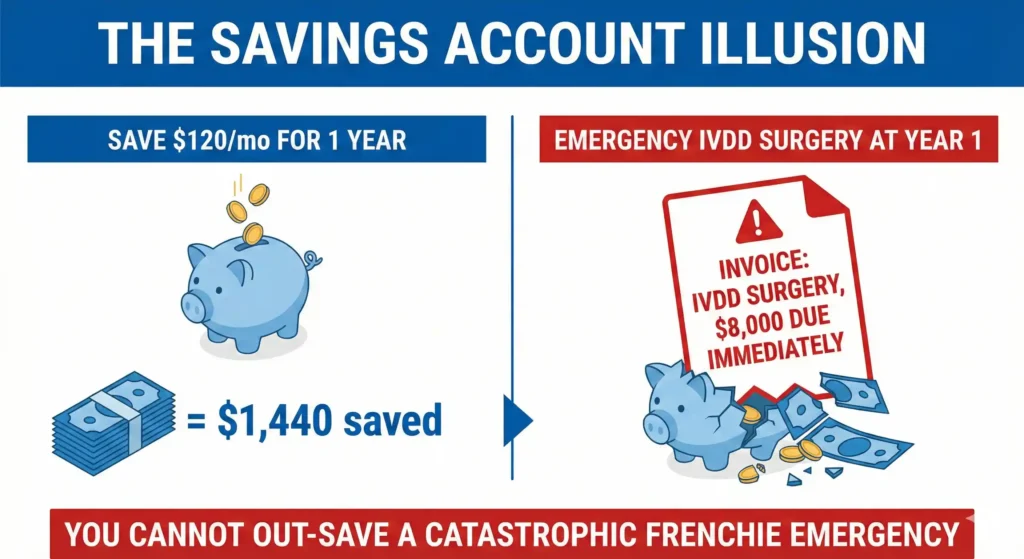
I hear the exact same question every day: “Pet insurance for my Frenchie is $120 a month. Is it really worth it, or should I just put that money in a savings account?” Let’s break down the exact math of what it costs to maintain a flat-faced breed in 2026, the specific surgeries you are statistically likely to face, and when paying an insurance company actually saves your financial life.
The Routine vs. The Catastrophic
To understand the math, you have to separate your vet bills into two categories: the things you expect, and the things that ruin your credit score.
Routine costs—like vaccines, flea and tick prevention, and basic wellness exams—are not why you buy pet insurance. According to the American Veterinary Medical Association (AVMA) guidelines on pet care costs, you should budget about $500 to $800 a year for standard maintenance.
But French Bulldogs do not stick to standard maintenance. Their bodies are genetic battlegrounds.
Because of their compact skeletons and flat skulls, Frenchies are biologically predisposed to catastrophic failures. These are not “$200 ear infection” problems. These are “$5,000 overnight ICU” problems.
The “Big Three” Frenchie Medical Bills
If you try to self-fund your dog’s healthcare by putting $100 a month into a savings account, you are betting against these three specific emergencies. Here is what they actually cost:
1. Brachycephalic Obstructive Airway Syndrome (BOAS)
Almost all Frenchies have compromised airways. If your dog starts choking in the summer heat, they will require a soft palate resection and stenotic nares surgery to open their windpipe. Because this requires a board-certified specialist and an oxygen-rich ICU recovery, the American College of Veterinary Surgeons (ACVS) categorizes brachycephalic airway interventions as complex, high-risk procedures.
- The Bill: $3,500 – $6,500.
2. Intervertebral Disc Disease (IVDD)
Frenchies are dwarfed breeds with long spines and missing vertebrae. If a disc slips in their back, they can become paralyzed in their hind legs overnight. Emergency spinal surgery (a hemilaminectomy) followed by weeks of physical therapy is one of the most expensive things in veterinary medicine.
- The Bill: $6,000 – $9,000.
3. Severe Allergic Dermatitis
Those cute wrinkles trap massive amounts of yeast and bacteria. I see owners visiting the vet every single month for Cytopoint allergy injections, medicated shampoos, and prescription diets just to stop their dog from scratching themselves bloody.
- The Bill: $1,000 – $2,500 annually.
The ROI Math: Insurance vs. Out-of-Pocket
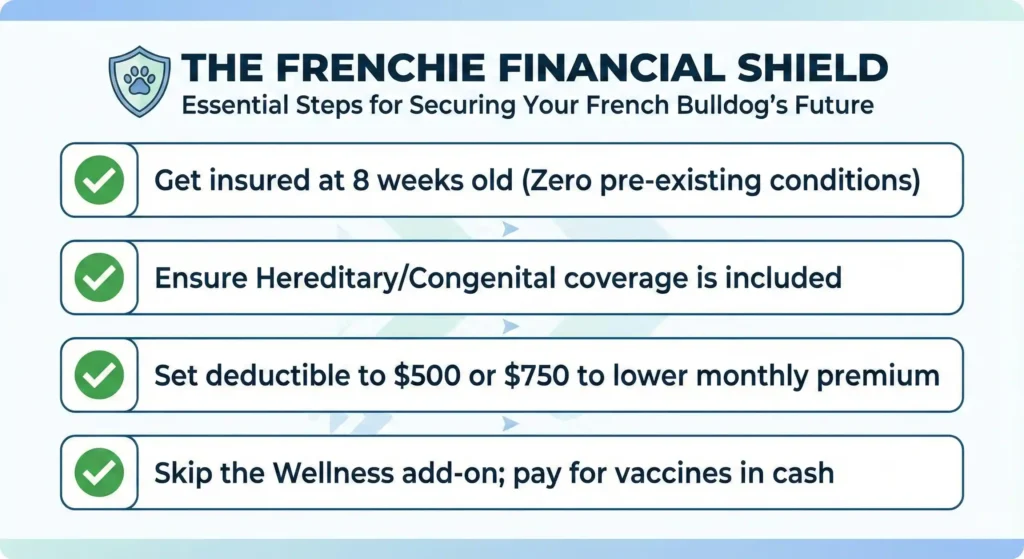
Let’s look at a real-world scenario. Imagine you buy a premium pet insurance policy for your 8-week-old Frenchie. You pay $120 a month for a policy with a $500 annual deductible and a 90% reimbursement rate.
At age two, your dog needs BOAS surgery ($5,000) and develops a severe cherry eye ($1,500).
Scenario A: You Did Not Have Insurance
- You paid $0 in monthly premiums.
- You pay the vet exactly $6,500 out of your savings.
Scenario B: You Had Pet Insurance
- You paid $120/month for 24 months = $2,880 in premiums.
- You pay your $500 deductible.
- You pay your 10% co-pay on the remaining $6,000 bill = $600.
- Your total out-of-pocket cost over two years: $3,980.
In this incredibly common scenario, having pet insurance kept $2,520 in your pocket. More importantly, when the vet handed you that $6,500 estimate, you didn’t have to debate whether you could afford to let your dog breathe. You just swiped your card, knowing a reimbursement check was coming.
When Does Pet Insurance Lose You Money?
I always want to be perfectly transparent: insurance is a calculated risk.
If you get incredibly lucky and your French Bulldog lives to be 10 years old without ever blowing a spinal disc, tearing a knee ligament, or needing airway surgery, you will have paid more in monthly premiums than you received in payouts.
But I can tell you from reviewing thousands of Frenchie claims that “the lucky, perfectly healthy Frenchie” is the exception, not the rule. The premium is high because the insurance algorithms know your dog is going to cost them money eventually.
The Final Verdict
Do not buy a French Bulldog if you cannot afford a $100 to $150 monthly insurance premium.
Trying to “wing it” with a breed that is scientifically prone to $8,000 spinal emergencies is financial suicide. Lock in a high-quality policy the very first day you bring the puppy home. Your future self—and your dog—will thank you.
Frequently Asked Questions (FAQs)
Should I get a “Wellness Plan” added to my pet insurance?
For a Bulldog, I rarely recommend it. Wellness riders cover routine things like vaccines and dental cleanings, but they usually cost an extra $30-$50 a month and cap how much they pay out. You are better off paying for routine care in cash and putting all your insurance budget toward a high-limit illness and accident policy.
Why did my insurance premium go up when my Frenchie turned 4?
Because pet insurance is heavily age-rated. As a dog ages, their statistical likelihood of getting cancer, arthritis, or heart disease skyrockets. Insurers adjust their premiums annually to reflect the increased risk of an older dog. This is why locking in a policy early is critical; if you try to buy a new policy at age 4, the base rate will be astronomical.
Will insurance cover my Frenchie’s skin allergies?
Yes, as long as the dog did not show any signs of skin irritation, ear infections, or paw licking before your policy’s waiting period ended. If they did, allergies will be permanently excluded as a pre-existing condition.
YMYL & Financial Disclaimer: The information provided on Flat Face Insurance is for educational and consumer advocacy purposes based on my independent analysis of 2026 US veterinary costs and insurance trends. I am not a licensed veterinarian or a financial advisor. Insurance premiums, deductibles, and veterinary pricing vary drastically by US state and provider. Always request a full sample policy document from the insurer and read the “Exclusions” page carefully before making a financial decision.
2 thoughts on “The “Frenchie Tax”: Why Your $4,000 Puppy Will Cost You $10,000 in Year One”